Human + AI Workforce

What changed?

Not the technology. The relationship.

Every twenty years, the question changes

Twenty years ago We bought computers
Ten years ago We adopted smartphones
Today Businesses are beginning to hire AI employees

Read that sequence again, because the last step is not like the first two.

A computer is a purchase. A smartphone is a purchase. You buy them, you own them, and nobody asks who a laptop reports to. But the moment work is handed to something that performs it on its own schedule and hands the result back, you have stopped buying a tool and started managing a worker.

Most organisations have not noticed this yet. They are still procuring AI the way they procured software (a licence, a login, a chat window), and then wondering why nobody can say who is accountable for what it produced.

So the thing that changed is not the technology. It is the relationship. And the word for that relationship is not AI, and it is not ChatGPT, and it is not agents.

Human + AI Workforce

The future of work isn’t humans versus AI. It’s organisations where Human Workforce and AI Workforce collaborate, each doing what they do best, under one accountable management system.

Managing two workforces is the beginning. Organisational Excellence is the destination.

“The Future of Work” is a category, and anyone can claim it. This is the part of it I work on.

Most of that conversation is still framed as a contest: what AI takes, what humans keep, how many roles disappear by which year. It is a compelling argument and it is the wrong one, because it treats the two as substitutes competing for the same seat.

They are not substitutes. They are two workforces with genuinely different strengths, and the interesting question was never which one wins. It is what kind of organisation can employ both at once, and hold both to account.

That question is not really about artificial intelligence. It is about management.

The Argument

Why this is a management problem

An organisation already knows how to employ people it cannot personally supervise every minute. It has job descriptions, standing responsibilities, delegated work, deadlines, review, approval, escalation, and a record of who decided what. That machinery is a management system, and it took a century to get right.

AI is currently being adopted outside that machinery, producing output nobody signed off, against obligations nobody declared, on a schedule nobody agreed. The work is often good. The accountability is missing.

My position is that AI does not need a new discipline. It needs the one we already have. An AI employee should have a role, standing responsibilities, deliverables that are expected before they exist, work delegated to it with deadlines, an approval gate it cannot cross, and the standing to say “I cannot do this, and here is why.”

Not a smarter assistant. A member of staff, inside the same system as everyone else.
A manager opens his laptop at eight in the morning and finds the night’s work already done. The brief written. The risks logged. Two decisions drafted and waiting for him.

That isn’t automation. Automation runs a process you designed.

That is an employee reporting for duty.

This already happens. It is what a scheduled AI employee does before anyone arrives, and the first time you see it, the word tool stops fitting.

One Organisation. Two Workforces. One Management System.

Human Workforce Judgement, relationships, accountability, and every decision that carries consequence
One Management System Roles, responsibilities, delegation, review and approval, applied identically to both
AI Workforce Continuous attention, recall at scale, and the standing work that never gets done

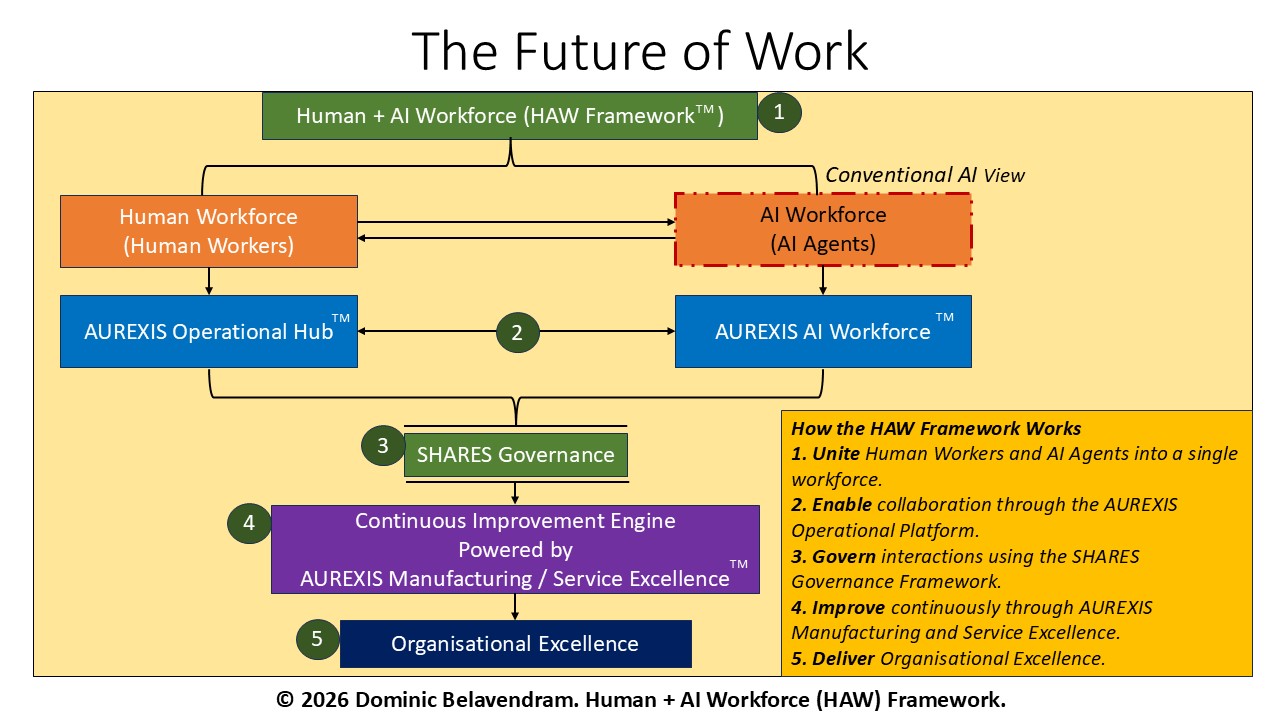
Human + AI Workforce (HAW) Framework™

A management framework for organisations where Human Workforce and AI Workforce work together under one accountable management system.

Governed by the

SHARES Principles™

S

Structure Before Scale

Adding AI to an organisation with unclear responsibilities does not clarify them. It multiplies the confusion at speed. The management system comes first. It always did.

AI multiplies whatever system already exists.

H

Humans Decide

An AI employee proposes, drafts, prepares and recommends. It does not commit the organisation to anything. That boundary is a design decision, not a technical limitation, and it should stay one.

AI recommends. Humans commit.

A

Accountability Is Not Optional

Work that nobody owns is not work; it is output. Every deliverable is addressed to somebody, every outward action is approved by a named person, and the record shows who decided.

Every decision must have an owner.

R

Responsible Refusal

A person handed impossible work says so at the desk, not at the deadline. An AI employee that only ever agrees is not a colleague; it is a function call that wastes your Friday.

A trustworthy AI knows when to say “No.”

E

Each Does What It Does Best

An AI workforce is tireless, consistent and has perfect recall, and no stake in the outcome. A human workforce has judgement, relationships and accountability. Designing either to imitate the other wastes both.

Machines scale. Humans judge.

S

Single System, Not Two

The moment AI is managed separately (its own tools, its own rules, its own reporting), the organisation has two operating models and no single view of who is responsible for what. One system, or it isn’t a workforce.

One organisation. One management system.

Every organisation will eventually manage two kinds of workforce.

The SHARES Principles™ ensure both are managed as one.

Where this comes from

I did not arrive at this from artificial intelligence. I arrived at it from quality systems, and from a career spent asking one question:

How do we design organisations so work gets done consistently, accountably, and well?

I led national-level TS 16949 implementation across Malaysia’s automotive sector. Underneath the paperwork, that work is one answer to that question, specifically to the hardest part of it: how an organisation guarantees something gets done properly by people it cannot watch. The answer was never motivation or talent. It was a system: defined responsibility, evidence, review, and a name against every decision.

Artificial intelligence has not changed the question. The answer has simply expanded. It now includes two kinds of workforce instead of one.

The future of work isn’t Human versus AI.

It’s Human + AI.

In Practice

Being built, not theorised

I am building this rather than writing about it. AUREXIS Workforce is the working proof: AI employees with declared responsibilities, deliverables expected before they exist, work delegated with deadlines and priorities, an approval gate nothing outward-facing crosses, and employees that decline work they cannot properly do.

It is early, and I would rather say so than oversell it. But every one of the SHARES Principles™ is enforced somewhere I can point at, which is the standard I would want applied to anybody making claims in this space.

AUREXIS Workforce is the first implementation of the HAW Framework™. The framework comes first. The software proves it.

The Human + AI Workforce (HAW) Framework: Human Workforce and AI Workforce united under the framework, collaborating through AUREXIS Ops Hub and AUREXIS Workforce, governed by SHARES, driven by a continuous improvement engine, delivering organisational excellence.
The HAW Framework™, assembled. Tap to open full size

Visit getaurexis.com →

From Workforce Management to Organisational Excellence

Managing two workforces is not the destination. It is the beginning of an improvement cycle.

Human employees improve through experience

They see what happened, draw a conclusion, and carry it into the next decision. Nobody has to install it.

AI employees improve through better knowledge, clearer authority and better management

An AI employee does not get wiser on its own. It gets better documents, a sharper brief, and a manager who answers it. Its performance is a reflection of how it is managed.

Managers improve through Coach Dom

Managing a workforce that works overnight, refuses work and drafts decisions is a skill nobody has been taught yet. Coach Dom watches how a person manages rather than what they produce, and reports to them and to nobody else.

The organisation improves through QualityAgent

An AI employee whose job is not departmental work but improving how the work is done. It reads what the others produced: what recurs, what was agreed and never happened, which advice was declined and why.

Put together, people, AI, management and organisational knowledge stop improving separately and start improving each other.

Every completed task becomes organisational knowledge. Every observation becomes an opportunity. Every recommendation strengthens the management system. Every improvement becomes tomorrow's standard.

This is where the traditional excellence disciplines belong. PDCA, root cause analysis, Lean and Six Sigma are not separate initiatives running alongside the workforce, competing with it for attention and budget. They are the improvement engine operating above it, and they finally have something continuous to work on.

Human Workforce + AI WorkforceWho does the work
HAW Framework™How both are managed
SHARES Principles™How managers govern both
AUREXIS WorkforceThe daily work, done and reviewed
Continuous ImprovementHow both keep learning
Organisational ExcellenceWhat the organisation becomes

Organisational Excellence is not achieved because AI performs work. It is achieved when people, AI, management systems and continuous improvement stop being four things and become one learning organisation.

The improvement disciplines themselves are a practice, not a platform. AUREXIS Excellence is where they live, as AUREXIS Manufacturing Excellence and AUREXIS Service Excellence, strengthening the Human + AI Workforce rather than sitting beside it.

Human + AI Workforce changes how work is done. Continuous Improvement changes how organisations learn.

Organisational Excellence is the result.

Where this sits

Industrial AgeWe organised labour
Knowledge AgeWe organised expertise
Digital AgeWe organised information
Human + AI Workforce AgeWe organise two kinds of worker

Where this goes

This is the body of work I intend to be associated with over the coming years: writing, frameworks, and systems for organisations that will soon employ both kinds of workforce and have no established way to manage either alongside the other. The HAW Framework™ and the SHARES Principles™ are the shape that work takes.

The category is the Future of Work. The contribution is Human + AI Workforce™, and the argument that it is a management problem before it is a technology one. Managing both well is how an organisation learns, improves continuously, and ultimately achieves Organisational Excellence.

Every organisation will eventually manage two kinds of workforce.

The question is not whether that future is coming.

The question is who will be ready for it.

Back to Home